

Robert Rope
Chapter 4: A Story To Tell

»Amid the chaos of New York's station and along a journey that seems to stretch on forever, Rob drifts through memories, nostalgia, and encounters that reflect a world in transition. But when his thoughts return to Mrs. Maria, the moment he first met her.«
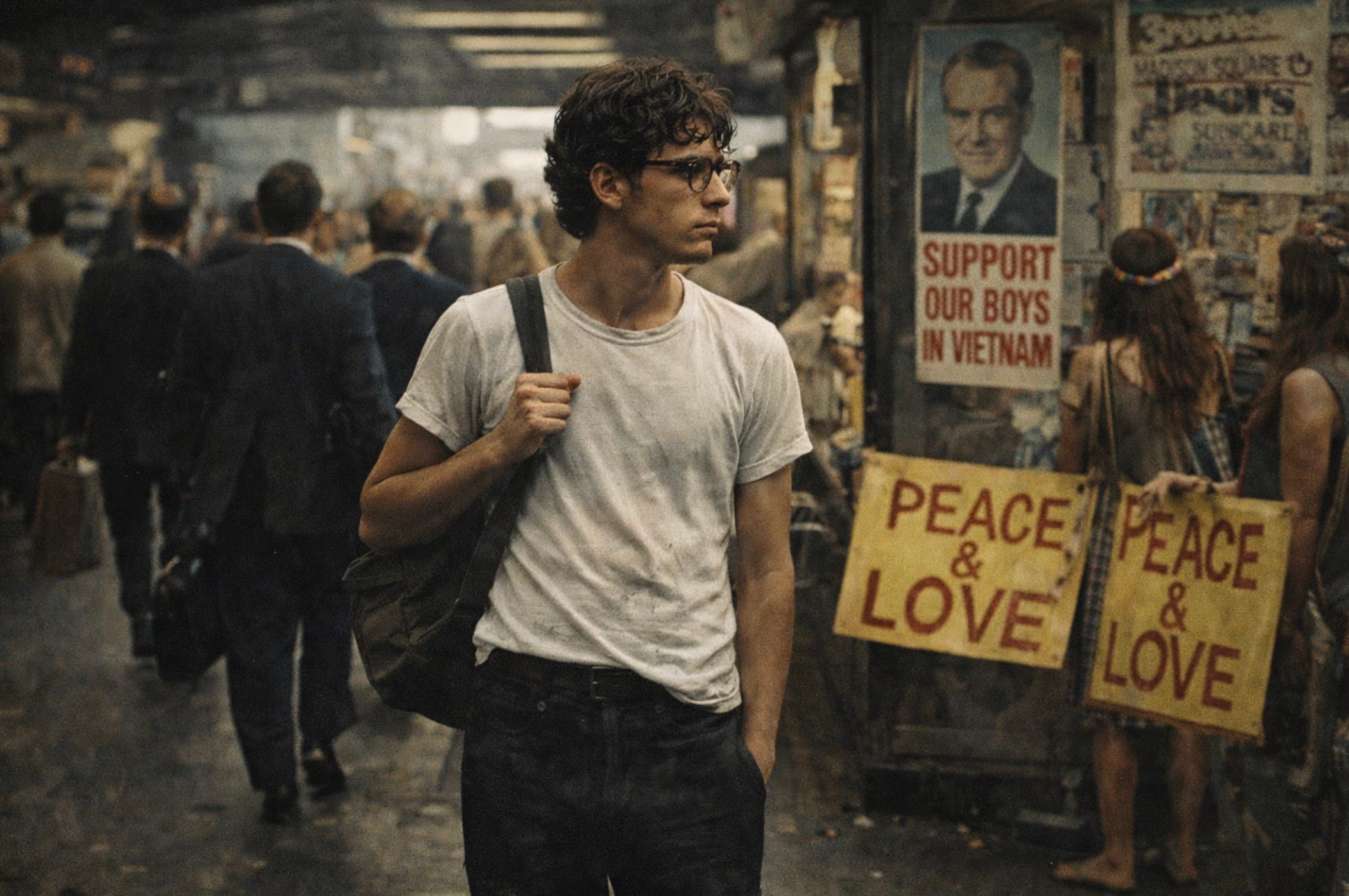
By mid-afternoon we rolled into the Port Authority in New York. While I waited for the next bus, I got swallowed by the chaos of that huge station, soaked in the smell of hot dogs and cigarettes. Men in suits hurried by with briefcases in their hands. Right next to them, barefoot hippies waved hand-painted signs that said
“PEACE & LOVE.”
Above a newsstand, Nixon’s face stared down under a headline that read
“SUPPORT OUR BOYS IN VIETNAM.”
A little farther on, a faded poster announced the Doors at Madison Square Garden — the January show. Twenty thousand people packed into the Garden. Record take. Legendary night. I’d wanted to be there.
But like always, I’d been somewhere else, working.
I frowned.
That’s how it always was. The big moments always passed me by. Back in Newport I’d met a guy who’d worked with the Doors’ road crew. A couple beers in, eyes shining, he started telling stories like he’d been there yesterday.
“Jim seemed possessed by the devil himself. The way he could improvise, man, it was unreal. When they kicked into Light My Fire, the whole place — hundreds, no, thousands! — jumped to their feet and sang it with him like one voice. Manzarek on the organ, Krieger on guitar… they did this solo I can’t even put into words. You had to be there. There was a whole orchestra onstage at the Garden, but Jim… Jesus. It was like he was conducting the whole thing, like his voice was the baton. I’ll never forget it.”
I stared at that poster and wondered if I’d ever get to see a show like that. The kind of concert I’d describe, if someone asked me, as the concert of my life.
I was starting to lose hope.
And the crazy part was, I’d seen plenty of concerts. Too many, maybe. When you work backstage you see the ugly stuff — tantrums, deals, compromises — and it kills the magic. After a while you stop feeling it the way the crowd does. For me it was a job, not a night out.
With all that running through my head, I caught myself humming, Come on baby, light my fire… while I hunted for the bus to Monticello. It took me a full hour to find my way through the mess and figure out which Short Line Trailways I was supposed to take.
Then we were off again, heading toward the Catskills.
For about three hours the bus climbed through hills and woods, and the world outside the window got softer, more quiet.
I was watching the trees slide by when it hit me and my breath caught.
The photo.
The one I’d left behind in my room, taped to the mirror. Me, Sylvia, and Mom — my girlfriend had snapped it on this perfect Saturday morning, pancakes still steaming on the table. I’d been staring at that picture every day for weeks.
And somehow, before leaving, I’d forgotten it.
I decided that as soon as I got where I was going, I’d call Mrs. Maria and ask her to mail it to me. She was kind like that. I could already hear her muttering to herself:
“See? I knew he’d forget something. Told him a hundred times to take everything.”
And she had. The last few days she’d even offered to help me pack, fussing the whole time.
One thought pulled another, and I realized how little I actually knew about her. I rode the rest of the way to Monticello with this guilty feeling in my chest. Meeting her had been pure chance or at least I’d assumed it was. She didn’t fill the air with advice. She didn’t talk about herself. She was just… there. Steady. Present.
And somehow that made me look inward.
Me, I’d never asked her a single thing.
The first time I saw her, I’d just arrived in Newport with Led Zeppelin and the crew. They’d booked a hotel all together, like always. Me, I was already thinking about letting them leave for San Diego without me, so I figured it’d be better to find my own place — the cheapest I could — somewhere I could be alone.
I still hadn’t talked to Richard, the tour manager. He had a reputation for not loving last-minute changes. I was afraid he’d get mad, refuse to pay me, or worse — mess up my name. Not that he’d ever treated me badly. We’d never even argued. But you never knew how people would react. So I made something up. Said I knew a girl nearby, said I was gonna stay with her. The crew laughed, threw a couple jokes my way, then let it go.
Near the crew’s hotel there was a bar. I went in, ordered a beer, asked the bartender if he knew somewhere cheap to stay. He gave me the address of a woman he knew. When I got there, she was out front beating the dust out of a rug.
“Afternoon,” I said. “I’m looking for Mrs. Maria.”
She looked up, frowning.
“Who’s looking?”
“Well, I—”
“I who?” she shot back, annoyed.
“Robert.”
“Yeah, I know.” She jerked her head. “Come in.”
She sat me down in the kitchen and showed me a slip of paper with the room prices scribbled on it. Mine wouldn’t be the biggest, but it was the cheapest — and that was fine by me. She ran through the prices by day, by week, by month. I told her I’d stay at least two weeks, but I couldn’t pay her right away. I figured that might be a problem.
“Pay when you can. Just pay,” she said. “And if you’re staying longer, tell me a couple days ahead. If someone comes by, I need to know what to say.”
Then she tucked the paper into the pocket of her apron.
I followed her upstairs to the first floor and she showed me the room.
The place looked like it hadn’t changed since the thirties. Soon as I stepped in, that old wood smell hit me. There was a desk in the corner, worn down from years of use, and a chair with armrests smoothed out by who knows how many people before me. A lamp with a paper shade sat on the desk, throwing off a soft glow — the kind I liked. Across from the bed, a big mirror showed the whole room, just a little off somehow. The bed was high, with a spring mattress that squeaked when I pressed on it. Reminded me of the one back home in Detroit. The built-in closet was way too big for the few things I carried. The window had a light, flowery curtain — real feminine. The wallpaper was floral too, peeling near the ceiling in a few spots. No mold, though.
All things considered, that room was better than a lot of places I’d slept in over the past few years.
Mrs. Maria told me that since I wasn’t her only guest, I had to let her know ahead of time if I wanted lunch or dinner. Then she added that after ten at night she didn’t open the door anymore — and if I knocked after midnight, she’d throw a pot of water over my head.
“Yeah, but sometimes the girls don’t come around right away,” I said, keeping a straight face even as the words sounded ridiculous. “Sometimes I’m out late. And once they do come around, I can’t exactly bring ’em here and then stand outside till dawn. The moment passes, you know. Things cool off… if you catch my drift.”
I was joking. Trying not to smile.
She didn’t move.
“Then I’ll make sure the water’s hot.”
I grinned and told her not to worry, with the work I did, I wasn’t coming home before sunrise anyway.
Then the days got busy. I worked a lot and hardly saw her. Until the Jazz Festival ended, Richard replaced me with the son of a friend, and the crew took off.
And for the first time in my life, I realized I was alone.
Back in Detroit, I always had family and friends close. After that, on the road, I bounced from crew to crew. New faces all the time, but I wasn’t alone.
I went back to the boarding house and it hit me: I wasn’t catching up to anyone.
And nobody was waiting for me.
That thought hollowed me out.
When I got in, instead of going up to my room, I sat down at the kitchen table. I just sat there, staring at nothing. Mrs. Maria walked behind me, turned on the tap, filled a glass of water.
“What is it, kid?” she asked, setting it in front of me.
I couldn’t answer.
So she pulled out her knitting from the cupboard, put on her glasses, and sat down across from me. Quiet as me, she started to knit. I kept staring at the glass. I was about to pull a cigarette from my pocket when she stopped me.
“No smoking in here. Put that garbage away.”
I did.
“You see this?” she said, holding up a little square of yarn. “You know what it is?”
“I don’t know. A scarf?”
“I don’t know either,” she said. “Could turn into a scarf. Could be a hat. Who knows. I’ve got time.”
I took off my sunglasses and set them on the table.
For the first time, Mrs. Maria looked me straight in the eyes.
Tears warmed my cheeks before I could stop them. I covered my face with my hands. She didn’t say a word. She waited until I calmed down and drank some water.
Only then did she speak.
“I don’t know a thing,” she said. “But I know there’s a story that needs telling.”
She adjusted her glasses, went back to knitting, and added:
“Go on. Start from the beginning.”
All rights reserved. © Grace V. Green (2025)
