
Modern Writer
10% Author, 90% Marketing

When I decided I wanted to become a writer, I had a fairly simple idea of what my life would look like.
I imagined long days spent chasing ideas, having imaginary arguments with fictional characters, and rewriting the same sentence ten times until it finally sounded right. I thought that was the heart of the job: sitting in front of a blank page and trying to fill it with something worth reading.
For a long time, I believed the hardest part would be finding the words.
I was wrong.
The words, after all, are the part I love. They can be stubborn, certainly, but at least they’re playing on my home field. The real challenge arrived later, when I discovered that writing a book doesn’t simply mean writing a book. It also means learning how to sell it, promote it, talk about it, and, above all, make the person behind it visible.
In other words, it means becoming your own marketing department.
I still remember the first time someone told me that having a good story wasn’t enough. If I wanted readers to find me, I needed an online presence. I needed to build a community, develop a personal brand, and learn how to communicate strategically.
I listened carefully because it sounded important. Yet the longer I listened, the stronger the feeling became that I had somehow wandered into the wrong room.
I wanted to write novels, not become a marketing campaign.
And yet, little by little, I convinced myself that perhaps I was the one who hadn’t kept up. So I started studying. I read articles, attended webinars, and listened to experts who seemed to possess the secret operating manual for the internet. They spoke with enviable confidence about a world ruled by mysterious algorithms that decided who would be seen and who would remain invisible.
Things became even more serious when I entered the kingdom of TikTok.
If the stories online are to be believed, TikTok possesses almost magical powers. Writers upload a video and wake up the next morning with thousands of new readers. After hearing enough of these success stories, I began to suspect that publishing success had less to do with writing and more to do with looking comfortable on camera.
Unfortunately, my experience has been somewhat different.
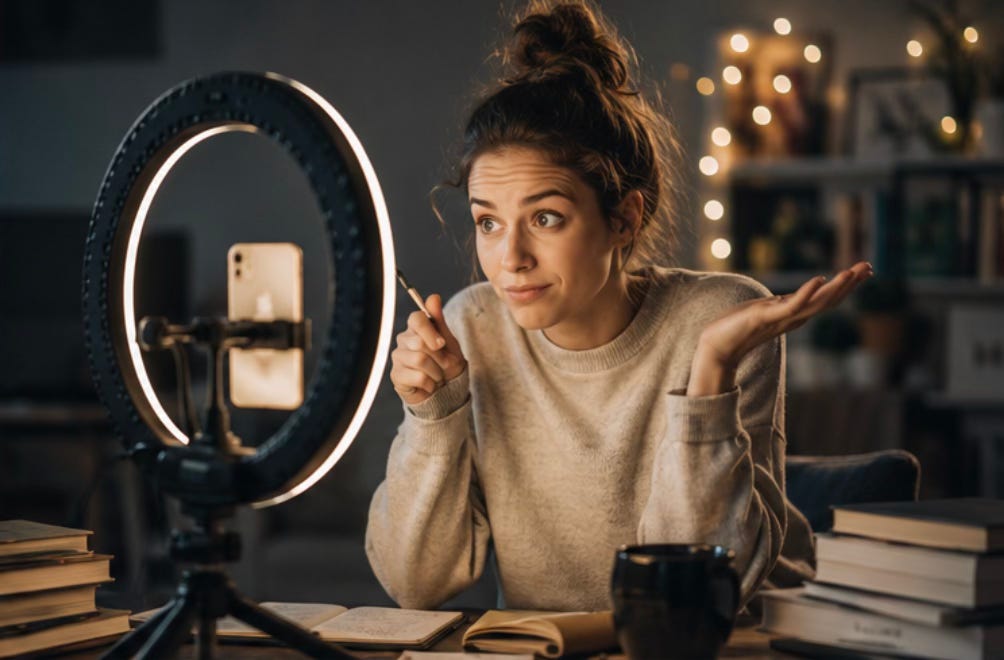
Every time I try to record a video, something inside me quietly shuts down. One second earlier, I’m capable of carrying on a perfectly normal conversation. The moment I press the record button, however, I transform into a Renaissance statue. Any trace of spontaneity disappears, my brain empties completely, and the final result invariably looks like footage of a hostage attempting to communicate in code.
Instagram has shown me no more mercy.
Every time I open the app, I find myself staring at profiles so beautifully curated that they inspire the same sense of awe I feel when walking into a Gothic cathedral. The colors are harmonious, the photographs seem related to one another, and every detail radiates professionalism.
Then I look at my own profile and I realize that my true area of expertise is improvisation.
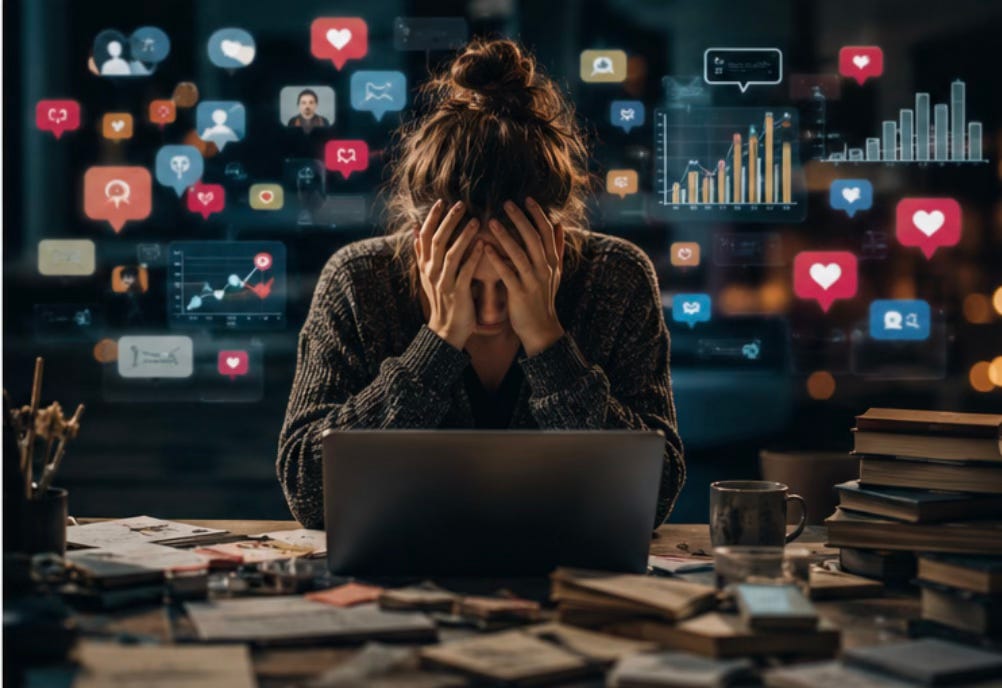
For a while, I tried to keep up. I studied analytics, examined graphs, and read explanations of concepts that often seemed closer to quantum physics than book promotion. In theory, I was learning how to reach new readers. In practice, I was spending more and more time staring at numbers and less and less time writing.
One evening, while looking at yet another dashboard full of metrics I barely understood, a question suddenly occurred to me.
When exactly had I stopped being a writer?
It wasn’t a dramatic realization. It was something quieter than that, which somehow made it harder to ignore.
As I stared at the screen, I no longer saw the person who had started writing because she loved stories. Instead, I saw someone chasing metrics, comparing performance, and trying to interpret signals from platforms that seemed to change their rules every other week.
It felt as though I had wandered very far from where I started, then I remembered something:
the stories came first.
They existed before social media, before algorithms, before analytics and content strategies. They were there when nobody was reading what I wrote, and they were still there waiting for me every time I returned to a blank page.
And that’s when I realized that I may never be the kind of person who can effortlessly chase every new trend. I’ll probably continue feeling awkward in front of a camera, and I’ll likely remain slightly envious of people who can transform a social media profile into a work of art. It’s entirely possible that I’ll never fully understand what an algorithm wants from me.
But I do know one thing:
I love writing.
I enjoy the feeling of stepping into a story and losing myself inside it for a few hours. I love those moments when a character suddenly comes alive and starts surprising even the person who created them. I love the fact that a simple idea can become something that didn’t exist before.
And in the end, no matter how much the publishing world changes, that’s the only part that truly matters. So,
I’ll keep writing.
Not because it’s the easiest way to get noticed, or it guarantees success, but because it’s the reason I started in the first place and despite everything, I still believe stories deserve to be told.
Even if, immediately after finishing this article, I’ll probably spend the next hour trying to convince an algorithm to show it to someone.


You're in good company. Pitting myself against the machine isn't my idea of a good time. This is just something I do; a place to inject my pathos. Readers are the final metric and greatest reward.
Just a hillbilly who can read and write.
I'm in the same boat, not comfortable on social media platforms. I put some novels on amazon and didn't advertise as I should have so no one knew they were there. I understand that facebook, amazon, and Bookbub ads are probably the best way to do that, but of course that takes time and money. It's also tough now to get traction unless you're writing in a popular genre, which I'm not. So I do it for the joy of it.